
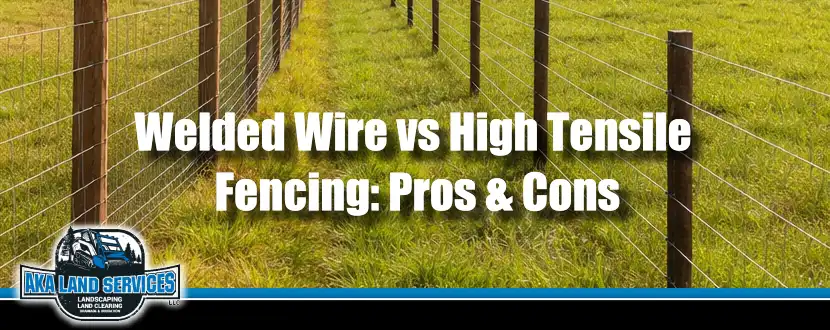
Welded-Wire Fencing vs High Tensile Fencing: What’s Best for Your Land?
If you own acreage, manage livestock, or are planning a perimeter upgrade, choosing the right fence is a bigger decision than most people expect. On the surface, fencing seems simple — put posts in the ground, stretch wire, and call it done. But the difference between welded-wire fencing and high-tensile fencing can mean thousands of dollars in costs, years of maintenance headaches, or smooth, long-term performance. The right choice relies on your land, your animals, and your long-term plans.
Let’s break it down in actual terms so you can decide which option actually fits your property — not just what looks good on a supply yard rack.
What Is Welded-Wire Fencing?
Welded-wire fencing is exactly what it sounds like: horizontal and vertical wires welded together at each intersection to form a rigid grid pattern. It typically comes in panels or rolls and is popular for smaller livestock, gardens, dog enclosures, and residential boundaries. Because the wires are welded rather than woven, the fence retains a consistent square or rectangular pattern that looks clean and uniform.
One of the biggest advantages is visual containment. If you’re keeping goats, sheep, or even poultry, welded wire provides tight spacing that prevents squeezing through. It’s also easy to see if an animal is pushing against it because the structure doesn’t flex much.
The downside? That rigidity can become a weakness. If a large animal hits it hard or a tree limb falls across it, the weld points can snap. Once a weld breaks, the integrity of that section declines quickly.
What Is High Tensile Fencing?
High tensile fencing uses smooth, strong steel wire stretched tightly between posts. Instead of rigid panels, the wire relies on tension and proper bracing. When installed correctly, it behaves almost like a spring — absorbing impact and returning to its original position. This makes it especially popular for cattle operations and larger acreage.
The wire itself is stronger than traditional low-carbon fence wire. Because it is stretched under significant tension, fewer posts are required compared to welded wire installations. That often reduces material costs on larger properties.
However, high-tensile fencing requires precise installation. Improper bracing or poor tensioning can lead to sagging lines and long-term maintenance issues.
- Welded wire works well for smaller livestock and residential uses.
- High tensile fencing shines on large acreage with cattle or horses.
- Installation quality matters more with high-tensile systems.
Strength and Durability in Real Conditions
In the Southeast, especially, weather plays a major role in fence performance. Humidity, heavy rain, and shifting soils can all impact longevity. Welded wire, if not heavily galvanized, can begin to rust at the weld points first. Those tiny intersections become corrosion targets over time.
High-tensile fencing, on the other hand, tends to withstand environmental stress better. Because the wire is designed to flex under pressure, it tolerates livestock leaning and minor impacts. It doesn’t “stay bent” the way welded panels often do.
That said, fallen trees are the great equalizer. Neither fencing type loves a 30-foot oak coming down on it. But high-tensile wire can sometimes be retensioned and repaired section by section, whereas welded panels often require the full replacement of damaged sections.
Installation Differences and Labor Considerations
If you’re hiring a contractor, labor cost can swing the decision. Welded-wire fencing typically requires closer post spacing to maintain rigidity. More posts mean more digging, more concrete (if setting), and more time.
High tensile fencing requires fewer line posts but demands strong corner braces and proper tensioning tools. It’s less forgiving during installation. A poorly braced corner will eventually fail — and when tension releases, it can affect long stretches of fence line.
DIY landowners often underestimate the skill required for high-tensile systems. It’s not complicated, but it is precise. The difference between “tight enough” and properly tensioned can determine whether your fence lasts five years or twenty.
Cost Comparison: Short-Term vs Long-Term
Upfront, welded wire often appears simpler and, on small projects, sometimes cheaper. For gardens, backyard livestock, or limited perimeter fencing, it can absolutely make financial sense.
For larger tracts, high-tensile fencing often wins on cost per foot because of reduced post requirements and greater material efficiency. Over time, maintenance may also be lower — especially for cattle operations where animals regularly push against fence lines.
The real cost factor isn’t just materials. It’s repairs. If you’re constantly fixing broken welds or replacing bent panels, your “cheaper” fence quickly becomes expensive.
Best Use Cases for Welded Wire
Welded wire is a strong option when containment of smaller animals is the primary goal. Goats, sheep, and dogs benefit from the tighter grid spacing. It also works well around gardens to deter deer when installed at an adequate height.
It’s visually tidy, which makes it appealing for properties near residential areas where appearance matters as much as function.
Best Use Cases for High Tensile Fencing
High tensile fencing is often the go-to for cattle, larger pastures, and perimeter fencing across rolling land. Because it can extend long distances with fewer posts, it adapts well to rough terrain.
For rotational grazing systems, it pairs well with electric wire setups, making pasture management more flexible. It’s built for acreage, not just backyard projects.
Maintenance and Long-Term Ownership Reality
No fence is “install it and forget it.” Walk your fence lines regularly. Check tension. Inspect weld points. Look for erosion around posts. Small fixes early prevent big repairs later.
Think about how you use your land now — and how you might use it in five or ten years. Changing livestock types later can mean redoing entire fence systems if you choose the wrong style upfront.
At the end of the day, the best fence is the one that fits your animals, terrain, and long-term goals. Both welded-wire and high-tensile fencing have their place. The key is pairing the material to the mission.